Friday, April 20, 2018

Was Christopher Columbus a Jew?


The popular concept of Christopher Columbus is that he was an Italian explorer, navigator, and colonizer. He was alleged to have been born in the Republic of Genoa on October 31, 1451.

At a time when European kingdoms were beginning to establish new trade routes and colonies, motivated by imperialism and economic competition, Columbus proposed to reach the East Indies (South and Southeast Asia) by sailing westward. This eventually received the support of the Spanish Crown, which saw a chance to enter the spice trade with Asia through this new route. During his first voyage in 1492, he reached the New World. Instead of arriving in Japan as he had intended, he landed on an island in the Bahamas archipelago that he named San Salvador. Over the course of three more voyages, he visited the Greater and Lesser Antilles, as well as the Caribbean coast of Venezuela and Central America, claiming all of it for the Crown of Castile.

Although he never wrote in what was said to be his native language (a Genoese version of Ligurian) he later learned Latin, Portugese, and (most importantly) Castilian, the language spoken in Spain. He was said to have a keen interest in the Bible, and he used that knowledge in order to convince the Catholic monarchy in Spain to lend him money for his voyages.

In 1485 and 1488, he appealed (unsuccessfully) for money from King John II of Portugal. Undaunted, he then applied for assistance from Genoa, Venice, and England. All of those appeals also proved to be futile. He finally found a benefactor in 1489, when the Catholic monarchs of Spain gave him a modest annual allowance, which later was increased to full support in January of 1492. On August 3, 1492, he finally set sail on the first of his four voyages to the New World, and land was finally sited on the morning of October 12.


To quote the old Avis ads, though, the truth about Columbus is “not exactly” the same as the story that we are all familiar with.


During Columbus' lifetime, Jews became the target of fanatical religious persecution.. On March 31, 1492, King Ferdinand and Queen Isabella proclaimed that all Jews were to be expelled from Spain. The Alhambra Decree especially targeted the 800,000 Jews who had never converted, and gave them four months to pack up and get out. The final date for them to leave was July 31 of 1492, which happened to be 3 days before Columbus first set sail for the New World.

The Alhambra Decree was a natural progression from the Spanish Inquisition, which was established on November 1, 1478. By the time the Inquisition was formally disbanded on July 15, 1834, an estimated 150,000 had been persecuted and tortured, and  between 3000 and 5000 people had been executed. If you take the time to read the details in the link below, you will discover that Jews were not the only target of the Inquisition.


As a result of the Alhambra decree and persecution in prior years, over 200,000 Jews converted to Catholicism and between 40,000 and 100,000 were expelled, an indeterminate number returning to Spain in the years following the expulsion. Those who stayed faced the death penalty. The Jews who actually converted to Catholicism were known as “Conversos”. The Jews who PRETENDED to convert to Catholicism, but secretly still practiced Judaism, were known as “Marranos”, or “swine”.  Inevitably, of course, some of the “Marranos” were “outed”. Tens of thousands of Marranos were tortured by the Spanish Inquisition. They were pressured to offer names of friends and family members, who were ultimately paraded in front of crowds, tied to stakes and burned alive. Their land and personal possessions were then divvied up by the church and crown.

The Alhambra Decree was formally and symbolically revoked on December 16, 1968, a full century after Jews had been openly practicing their religion in Spain, and synagogues were once more legal places of worship under Spain’s Laws of Religious Freedom. In 2014, the government of Spain passed a law allowing dual citizenship to Jewish descendants who apply, to "compensate for shameful events in the country's past.. Thus, Sephardi Jews who can prove they are the descendants of those Jews expelled from Spain because of the Alhambra Decree can "become Spaniards without leaving home or giving up their present nationality”.

Recently, a number of Spanish scholars, such as Jose Erugo, Celso Garcia de la Riega, Otero Sanchez and Nicholas Dias Perez, have concluded that Columbus was actually a Marrano, whose survival depended upon the suppression of all evidence of his Jewish background in face of the brutal, systematic ethnic cleansing.

Columbus, who was known in Spain as Cristóbal Colón and didn't speak Italian, signed his last will and testament on May 19, 1506, and made five curious -- and revealing -- provisions.

Two of his wishes -- tithe one-tenth of his income to the poor and provide an anonymous dowry for poor girls -- are part of Jewish customs. He also decreed to give money to a Jew who lived at the entrance of the Lisbon Jewish Quarter.
On those documents, Columbus used a triangular signature of dots and letters that resembled inscriptions found on gravestones of Jewish cemeteries in Spain. He ordered his heirs to use the signature in perpetuity. 

According to British historian Cecil Roth's "The History of the Marranos," the anagram was a cryptic substitute for the Kaddish, a prayer recited in the synagogue by mourners after the death of a close relative. Thus, Columbus' subterfuge allowed his sons to say Kaddish for their crypto-Jewish father when he died. Finally, Columbus left money to support the crusade he hoped his successors would take up to liberate the Holy Land.

Estelle Irizarry, a linguistics professor at Georgetown University, has analyzed the language and syntax of hundreds of handwritten letters, diaries and documents of Columbus and concluded that the explorer's primary written and spoken language was Castilian Spanish. Irizarry explains that 15th-century Castilian Spanish was the "Yiddish" of Spanish Jewry, known as "Ladino." At the top left-hand corner of all but one of the 13 letters written by Columbus to his son Diego contained the handwritten Hebrew letters bet-hei, meaning b'ezrat Hashem (with God's help). Observant Jews have for centuries customarily added this blessing to their letters. No letters to outsiders bear this mark, and the one letter to Diego in which this was omitted was one meant for King Ferdinand.

In Simon Weisenthal's book, "Sails of Hope," he argues that Columbus' voyage was motivated by a desire to find a safe haven for the Jews in light of their expulsion from Spain. Likewise, Carol Delaney, a cultural anthropologist at Stanford University, concludes that Columbus was a deeply religious man whose purpose was to sail to Asia to obtain gold in order to finance a crusade to take back Jerusalem and rebuild the Jews' holy Temple
.
In Columbus' day, Jews widely believed that Jerusalem had to be liberated and the Temple rebuilt for the Messiah to come. Scholars point to the date on which Columbus set sail as further evidence of his true motives. He was originally going to sail on August 2, 1492, a day that happened to coincide with the Jewish holiday of Tisha B'Av, marking the destruction of the First and Second Holy Temples of Jerusalem. Columbus postponed this original sail date by one day to avoid embarking on the holiday, which would have been considered by Jews to be an unlucky day to set sail. (Coincidentally or significantly, the day he set forth was the very day that Jews were, by law, given the choice of converting, leaving Spain, or being killed.)

Columbus' voyage was not, as is commonly believed, funded by the deep pockets of Queen Isabella, but rather by two Jewish Conversos and another prominent Jew. Louis de Santangel and Gabriel Sanchez advanced an interest free loan of 17,000 ducats from their own pockets to help pay for the voyage, as did Don Isaac Abrabanel, rabbi and Jewish statesman.
Indeed, the first two letters Columbus sent back from his journey were not to Ferdinand and Isabella, but to Santangel and Sanchez, thanking them for their support and telling them what he had found.

The evidence seem to bear out a far more complicated picture of the man for whom our nation now celebrates a national holiday and has named its capital, and it is a very complicated story for three reasons:
1)    In recent years, Columbus has been criticized for starting the slave trade in America, even though the first slaves from Africa did not leave until after his voyages. However, the Papal Bull of 1493 gave almost all of the New World to Spain, the Spanish started to send slaves from Africa to America. The first enslaved Africans arrived in Hispaniola in 1501. The slave trade finally peaked in the late 18th Century. The U.S. states of Alaska, Hawaii, Oregon, South Dakota, and Vermont do not recognize Columbus Day at all; but they mark the day with an alternative holiday or observance. Hawaii celebrates Discoverer's Day, which commemorates the Polynesian discoverers of Hawaii on the same date, the second Monday of October. though the name change has not ended protest related to the observance of Columbus's discovery. The state government does not treat either Columbus Day or Discoverer's Day as a legal holiday. State, city and county government offices and schools are open for business. Similarly, in 2016, Vermont started celebrating Indigenous Peoples' Day instead of Columbus Day. Because this change was made by Governor Peter Shumlin's executive proclamation, it only applies for 2016. In the future it would have to be issued by the sitting governor on a yearly basis, or officially changed by the legislature in order to become permanent.On the other hand, South Dakota celebrates the day as an official state holiday known as Native American Day. Until 2017, Oregon did not recognize Columbus Day, either as a holiday or as a commemoration; schools and public offices remained open. However, on Columbus Day, 2017, Oregon Governor Kate Brown renamed the holiday "Indigenous Peoples' Day," to remember these cultures and commemorate the struggles of native peoples during European colonization. Two additional states, Iowa and Nevada, do not celebrate it as an official holiday, but the states' respective governors are "authorized and requested" by statute to proclaim the day each year.
      Several other states have removed the day as a paid holiday for government             workers while still maintaining it either as a day of recognition, or as a legal             holiday for other purposes. These include California and Texas.
 The city of Berkeley, California, replaced Columbus Day with Indigenous Peoples' Day in 1992, a move which has been followed by multiple other localities including Sebastopol and Santa Cruz, California; 
Dane County, Wisconsin; Seattle, Washington; Missoula, Montana; 
Cambridge, Massachusetts; Denver, Colorado; Phoenix, Arizona; Los Angeles, California; Austin, Texas; and Salt Lake City, Utah. Various tribal governments in Oklahoma designate the day Native American Day, or name it after their own tribe.
  
The first celebration in America has been recorded as early as 1792, when it was started by the Tammany Society in New York City. In 1892, President Benjamin Harrison called on people to celebrate the 400th anniversary of Columbus’ landing in the New World. In April 1934, as a result of lobbying by the Knights of Columbus and New York City Italian leader Generoso Pope, Congress and President Franklin Delano Roosevelt proclaimed October 12 a Federal holiday  under the name Columbus Day. Since 1971, the holiday has been fixed at the second Monday in October.  It is generally observed nowadays by banks, the bond market, the U.S. Postal Service, other federal agencies, most state government offices, many businesses, and most school districts


2)   One of the real reasons wanted to sail to the New World was to find a safe place to live for his fellow Jews, which would allow them to escape from persecution by Catholic rulers in Spain and Portugal. As a result, it is ironic that the biggest push for the holiday in America was a result of the efforts by the Knights of Columbus in 1934 in New York City.

3) The year 1973 provided another example of an ironic event, when the Yom Kippur War (which started on October 6 and ended on October 25) neatly bracketed the celebration of Columbus Day in that year.

 As we witness bloodshed the world over in the name of religious freedom, it is valuable to take another look at the man who sailed the seas in search of such freedoms -- landing in a place that would eventually come to hold such an ideal at its very core.


Wednesday, April 18, 2018

the moon landing was faked, version 2


A few weeks ago, veteran broadcaster Ted Koppel interviewed FOX commentator Sean Hannity. At the end of the interview, Mr. Koppel told Michael Cohen’s “mystery client” Sean Hannity that he was bad for America. In Koppel’s words, “you have attracted people who are determined that ideology is more important than facts.”

https://www.youtube.com/watch?v=tmaKl0Zm2c4


Koppel is absolutely correct, but Sean Hannity is far from the first person to use “fake news” to attract an audience. The phrase “yellow journalism” first came into being in the late 1800’s, when William Randolph Hearst competed with Joseph Pulitzer for circulation. Although both men occasionally would publish sensational stories to move their papers, Pulitzer “got religion in the early 1900’s, and focused only on solidly researched articles.


Seven years before his death in 1911, Pulitzer made a provision in his will for the establishment of Pulitzer Prizes as an incentive for newspaper journalism. To date, the New York Times and the Washington Post have won the most Pulitzer Prizes, which is why I read both newspapers every day that I can.


Not everyone in this country relies on reliable news sources for information, which is why some of our fellow citizens hold some very wacky views, and theories about the moon landing are among those views. The link below mentions that as much as 20% of our population believes that the moon landing was faked, and nothing you can do or say will change their minds.


Despite the fact that over 90% of the scientific community believe that global warming is happening, and is caused by human activity, there are a LOT of people who simply do not believe it. In our general population, only about 25% believe that global warming is real, and that it is caused by human activity.


So, if a whole bunch of people do not believe the FACTS about global warming, what DO we believe in more than global warming? Well, here is a short list for you:

1)    Only 38% of Americans believe that the Civil War was fought about slavery.

2)   Only 44% of our population are confident that vaccines don’t cause autism.

3)   51% of our population does not trust the Big Bang theory (which was discovered by a Catholic priest named Georges Lemaitre).

4)   Over 40% of our population believes that the earth is less than 10,000 years old, and only 27% believe that the earth is 4.5 billion years old, which is the consensus figure amount scientists.

5)   Only 60% of our population believe in evolution, compared to 97% of scientists who do.

6)   25% of Americans believe that the sun revolves around the Earth, despite the fact that Copernicus proved otherwise in the 16th Century. Because the teachings of Copernicus contradicted the teachings of the Catholic Church, he was placed under house arrest. The Church did not admit its error until the 20th century.

7)   55% of our population believe that America was founded as a Christian nation. Although it IS true that roughly 70% of our population would consider themselves to be Christian, our Founding Fathers (after considering history’s wars of religion and religious abuses in the American colonies) wisely chose to establish our new country as a sectarian (non religious) nation.

8)   77% of our population believe in angels, a much higher percentage than the views held by the rest of the country’s in the world. (Only one third of British citizens believe in angels, and less than 15% of the Scandinavian countries even believe in the existence of God).   I’ve experienced enough “miraculous” good fortune in my life that I would consider myself to be a believer also, but I don’t believe that angels can moved buildings – but there are people that do. The video below claims that the home of Mary in Nazareth was ultimately transported to Loreto, Italy by four angels, who literally made it happen overnight.


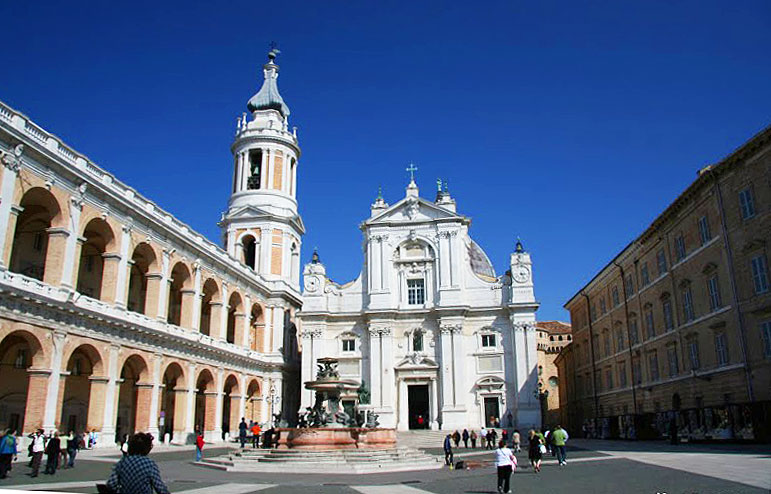
Pius devotees believe that the 4 angels transported Mary’s home from Jerusalem to Tersatto, Croatia in the 13th century, and later transported the home to Recanati, Italy. Ultimately, it was again transported by angels to its current location in Loreto, Italy, which is today the site of the Basilica della Santa Casa, which has been a popular pilgrimage site since at least the 14th century.


See the source image


I’m of the opinion that the house that was originally located in Jerusalem COULD have been moved to other locations by the Crusaders at various points in time, but I’m a little skeptical about “the rest of the story”.

I’ve often said that nobody’s opinion is ever wrong – it’s simply their opinion. However, regardless of what you belief, it’s always important to consider the source of your information.

Edward James Martin “Ted” Koppel earned his bachelors degree from Syracuse University, and his masters from Stanford. Koppel’s broadcasting career started in 1963, when he became the youngest correspondent ever hired by ABC Radio News, and he is still active today, at the age of 78. He is best known as the host of Nightline, which he was associated with from 1979 until 2005. During his broadcasting career, he has won numerous awards, including an incredible 25 Emmy awards.

Sean Hannity attended New York University, UC Santa Barbara, and Adelphi University, but never graduated. He started working for FOX in 1996, where he became the proponent of a wide variety of conspiracy theories. He HAS received a few rewards, but they pale in comparison to the achievements of Ted Koppel. Hannity’s aversion to truth has not hurt him financially, since his income in 2017 was $36 million. His net worth is estimated to be $80 million, which is considerably higher than Ted Koppel’s estimated net worth of $30 million.

At the time of his death, Joseph Pulitzer was worth an estimated $30 million, which was an enormous amount of money in 1911. His competitor, William Randolph Hearst, was a poor money manager, and was forced to sell most of his assets in the 1930’s.

Joseph Pulitzer exemplified the fact that acting with honesty and integrity can often be very rewarding financially. Sean exemplifies that fact that sometimes crime (and lying) pay very well - so be careful who you listen to.


Tuesday, April 10, 2018

Read, you idiot, read


“An educated citizenry is a vital requisite for our survival as a free people". 

Although this quote has long been attributed to Thomas Jefferson, there is no proof that he either said it or wrote it. However, it IS an accurate paraphrase of his views on education. As a result, freedom of the press is included in the very first amendment to the Constitution of the United States. His attitude also inspired him to found the University of Virginia in Charlottesville, Virginia in 1819. 

Although our fellow citizens are now the best educated in our country's history (34.6% have a college degree), too many of us simply do not read enough.


As more and more of our fellow citizens get their news from electronic sources, circulation of traditional print newspapers continue to decline, and the New York Times exemplifies the trend. As of January of 2017, the Times had added 308,000 new digital subscriptions (largely due to Trump), but print ad revenue (which is more lucrative than digital ad revenue) had declined by 18% in the first quarter of 2017.


One of the many victims of this trend is the Denver Post, which is now owned by Alden Global Capital, a New York-based hedge fund. Alden Capital’s subsidiary, Digital First Media, actually runs the paper.


Last weekend, the editorial board of the 125 year old newspaper blasted its owners, a bold move that was supported by Denver’s mayor, Michael Hancock. Due to the dramatic staff cuts forced by its owners, the Denver Post is essentially looking for a new owner. That is precisely what happened to the L.A. Times, which had been owned by Tronc. It is now owned by Dr. Patrick Soon-Shiong, a billionaire medical entrepreneur, who had been a major shareholder in Tronc.

Digital First Media is among the biggest newspaper chains in the country, with more than 90 newspapers including The Pioneer Press of St. Paul, Minn.; The Mercury News of San Jose, Calif.; The Orange County Register; and The Boston Herald. The company has aggressively cut resources in its quest for profit, with recent staff reductions at several of its papers, including The Mercury News and The Herald.

Alden’s strategy follows a pattern: It typically buys newspapers at a bargain — it purchased The Herald for roughly $12 million — before cutting costs. If you saw the movie, “The Post”, you may remember that Catherine Graham bravely decided to publish the Pentagon papers at roughly the same time as the company decided to go public. Her gamble worked, and the newspaper survived.

Although the company continues to be profitable, chief executive Donald E. Graham recently decided to sell the family newspaper in order to better survive in today’s environment, and he quickly found a buyer – Jeff Bezos, who personally paid $250 million in cash for the newspaper.


Since its founding, the Washington Post has earned 47 Pulitzer Prizes, second only to the New York Times, which has earned 122. In order to continue to produce the quality journalism that led to those awards, newspapers need an adequate number of journalists on staff, which companies like Alden Global Capital simply do not understand.

Although immigrant bashing seems to be becoming more popular again, it is worth noting that Jeff Bezos (the world’s richest man) was actually raised by a Cuban immigrant named Miguel Bezos, who married his mother 5 years after she gave birth as a 17 year old high school student.

Another immigrant who has had a profound affect on our society is a Scottish immigrant named Andrew Carnegie, who used his vast fortune to fund a total of 2509 Carnegie libraries between 1883 and 1929.


Carnegie’s philosophy of life can be summed up by “the Andrew Carnegie Dictum”:

·         To spend the first third of one's life getting all the education one can.
·         To spend the next third making all the money one can.
·         To spend the last third giving it all away for worthwhile causes.


Carnegie was a strong believer in philanthropy, even at an early age. By the time of his death in 1919, he had already given away $350 million ($77 billion in 2015 dollars). After his death, his remaining $30 million was given to foundations, charities, and pensioners. His belief in getting an education not only applied to himself, but to others as well, which is why he started paying for libraries  in 1883.


Carnegie believed in giving to the "industrious and ambitious; not those who need everything done for them, but those who, being most anxious and able to help themselves, deserve and will be benefited by help from others." Under segregation black people were generally denied access to public libraries in the Southern United States. Rather than insisting on his libraries being racially integrated, Carnegie funded separate libraries for African Americans. For example, in Houston he funded a separate Colored Carnegie Library. The Carnegie Library in Savannah, Georgia, opened in 1914 to serve black residents, who had been excluded from the public library. The privately organized Colored Library Association of Savannah had raised money and collected books to establish a small Library for Colored Citizens. Having demonstrated their willingness to support a library, the group then petitioned for and received funds from Carnegie. Future U.S. Supreme Court Justice Clarence Thomas wrote in his memoirs that he frequently used it as a boy, before the library system was desegregated.

Carnegie’s generosity allowed a large number of people to read more books than they could afford to buy on their own. Among all Americans, the average number of books read (or listened to) last year was 12. My wife read 113, which is WAY above the national average. At last count, the two of us owned over 500 books, a far better use of $10,000 than a large screen TV would have been. Samsung’s QN88Q9F has an 88” screen that you can buy for $20,000, but the MOST EXPENSIVE television currently available is priced at $2.25 million.


Women read more than men, and folks with higher education and income read more that folks with less education an income, but the ubiquity of public libraries in this country means that ANYONE with a desire to learn can become well informed if they set their mind to it.

In today’s society, all sorts of reliable news sources (network television, CNN, old line newspapers, and public radio) are being called “fake news”, while highly suspect sources like FOX “news”, Breitbart, Infowars, WorldNetDaily, and The Daily Caller are trusted by lots of people who should know better.


I recently monitored a classroom where a “media literacy course” was being taught. Its purpose was to help students distinguish between “fake” and “real” news – and reading lots of books and newspapers can help them do that. Many historians consider JFK to be one of the 10 best presidents in our history. He could read approximately 2500 words a minute (10 times faster than average), which allowed him to read LOTS of books, and six newspapers every morning.

Donald Trump does not read, and was recently voted the WORST president in our country’s history by the 2018 Presidents and Executives Politics Presidential Greatness Survey.

 As a society, we still watch a lot of TV, but slightly less than we used to. Older Americans watch the most (an average of 50 hours per week), but the balance of our society averages about 35.


I have to admit that I average less than that (at most, about 35 hours a YEAR), but I also spend a lot of time reading. In that regard, my philosophy is similar to the ideas of Andrew Carnegie. If you want to continue learning as you grow older, there is only way solution:

“read, you idiot, read”